


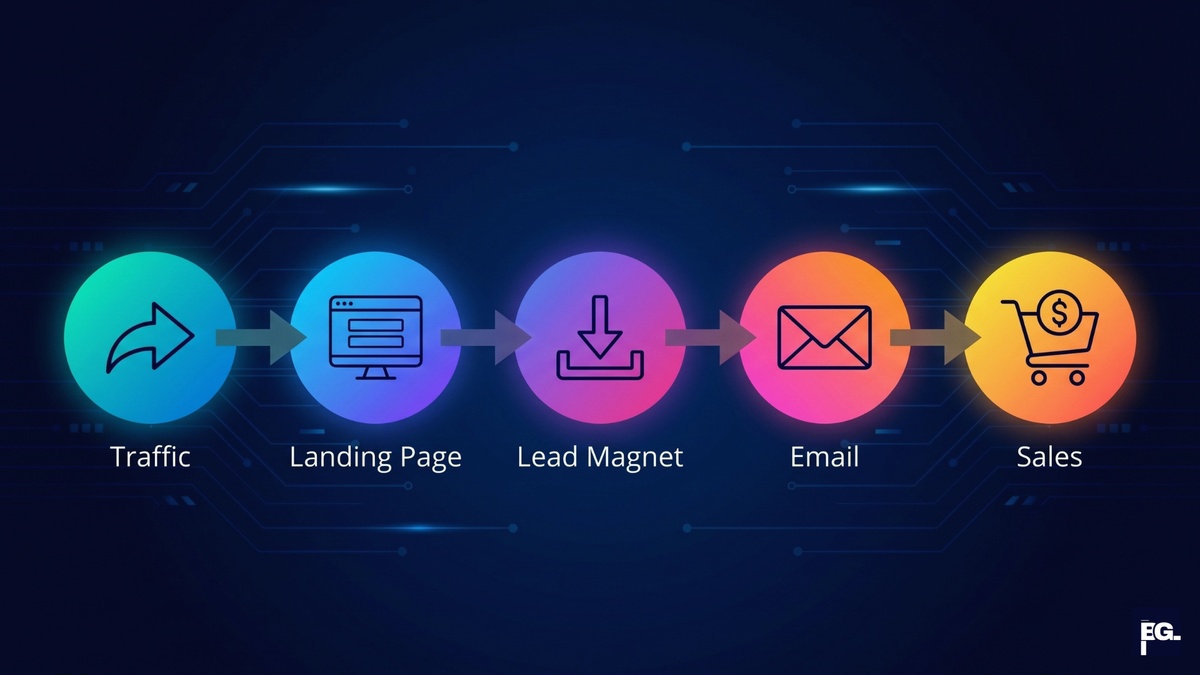
Quick snapshot: the lead generation playbook
| Step | What it looks like in real life | Simple way to apply it |
|---|---|---|
| Clear customer profile & offer | Campaigns targeting “anyone” | Write 1–2 ideal customer profiles and one core offer per campaign |
| Content & SEO | Traffic but wrong visitors | Create problem-focused blogs and guides for your ideal customers |
| Focused landing pages | Ads go to homepage | Build one landing page per offer with a single CTA |
| Lead magnets & forms | “Contact us” is the only option | Add demos, checklists, trials, or calculators by intent |
| Email & nurture | Leads get one follow-up email | Build a simple 4–6 email sequence for each key offer |
| Lead scoring & routing | Sales gets every lead | Score leads by fit + behavior and route only qualified ones |
| CPL & funnel tracking | No cost per lead by channel | Track CPL, conversion, and revenue per channel and campaign |
| Sales–marketing alignment | Sales says “these leads are bad” | Agree on what MQL (Marketing Qualified Lead) and SQL (Sales Qualified Lead) really mean for your business |
| Testing & optimization | “Looks good” is the only test | A/B test headlines, creatives, and offers regularly |
| Feedback loop | Same campaigns all year | Review performance monthly and double down on what works |
Step 1: Get clear on your ideal lead and offer

When a client tells me “our lead generation isn’t working,” the first thing I check is not their ads, it’s their ideal customer profile (ICP) and their offer.
If you’re trying to reach “any business that might buy,” your messaging gets vague, your targeting gets broad, and your cost per qualified lead usually goes up. Good lead generation in digital marketing starts with knowing exactly who you want and what you want them to do next.
How to put this into practice
- Write down 1–2 ideal customer profiles: industry, company size, role, main pain points, buying triggers.
- Choose one primary offer per campaign: demo, consultation, free audit, downloadable guide, or trial.
- Make your offer specific: “30-minute GA4 and funnel review for B2B SaaS founders” will almost always convert better than “free consultation”.
Example: For a B2B SaaS client, instead of running generic “book a demo” campaigns, we narrowed the ICP to mid-market marketing managers and changed the main offer to “Free 20-minute funnel breakdown with benchmarks vs your industry.” Qualified leads increased, and sales said conversations felt more relevant from the first call.
Step 2: Use content and SEO to attract the right visitors
Once you know who you want, you need to bring them in. This is where content, SEO, and useful resources do the heavy lifting for lead generation digital marketing.
Research from Demand Metric and the Content Marketing Institute shows that content marketing can generate around 3× more leads than traditional outbound marketing while costing roughly 62% less per lead, which is a major advantage if you're watching CPL. (Digital Applied / Trustar).
How to put this into practice
- Create content around real problems: “how to qualify B2B leads”, “how to fix low landing page conversion”, “how to choose a marketing CRM”.
- Use each article to point to a relevant lead magnet: a checklist, template, or calculator tied directly to the topic.
- Optimize posts for search keywords your ICP actually uses, but write like you’re explaining it to a real person, not a robot.
Example: According to HubSpot's research, companies that blog consistently generate around 67% more leads per month than those that don't publish regular content. When we added consistent problem-focused blogs plus relevant lead magnets for one client, organic leads became their most cost-effective channel over a few months.
If you’re building a content strategy, it also helps to understand the platform behind it. Read our full guide on what a content management system is to see how CMS tools help you manage, publish, and scale content more easily.
Step 3: Send traffic to focused landing pages
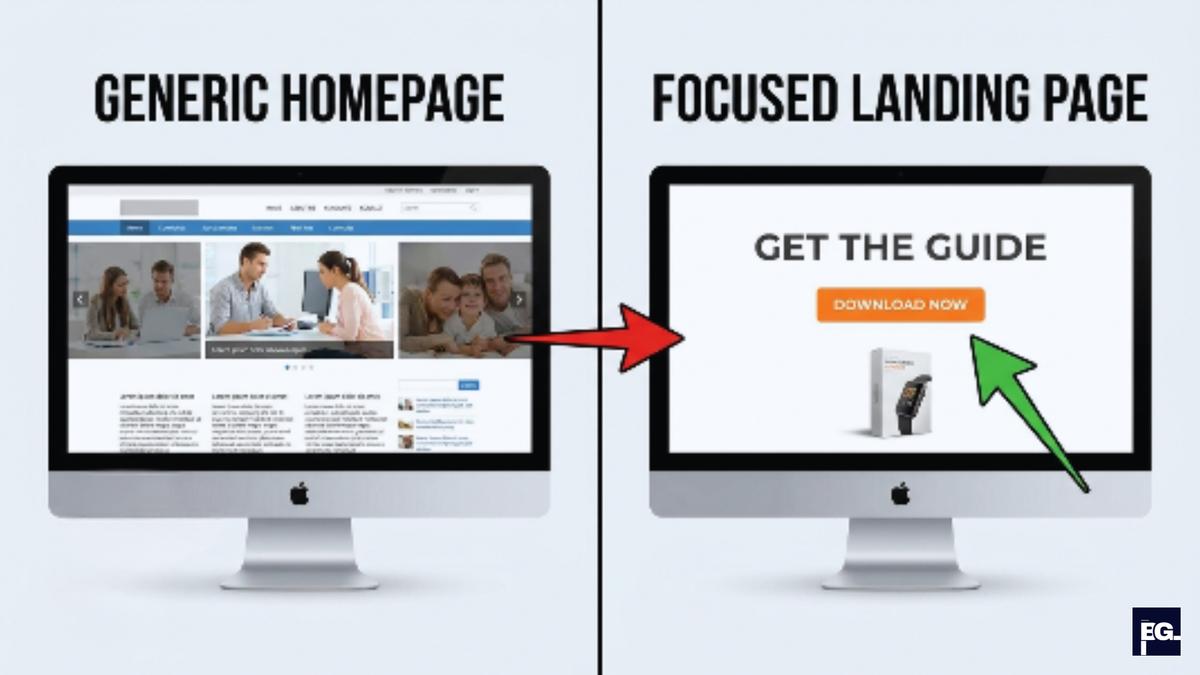
A common leak in lead generation in digital marketing is sending ad traffic or email clicks to a homepage or a generic service page. People get distracted, scroll a bit, and leave.
Recent benchmark data from Unbounce found that the median landing page conversion rate across industries is about 6.6%, with top performers hitting 10% or more. That improvement usually comes from focused pages: one offer, one clear CTA, one main message.
How to put this into practice
- Build at least one dedicated landing page for each major offer (demo, assessment, webinar, template).
- Remove navigation clutter and side distractions, keep the page focused on the next step you want the visitor to take.
- Use social proof, clear benefits, and a short form near the top, with more details below for people who want to read.
Example: For a client running LinkedIn ads, we switched from sending clicks to the generic “Services” page to a specific landing page offering a “B2B pipeline health audit.” Using the same ad spend, their landing page conversion rate moved closer to the 6–10% benchmark instead of hovering around 2–3%.
Step 4: Use lead magnets and forms that match intent
Not everyone is ready to “talk to sales” right away. If your only CTA is “contact us,” you are going to lose a lot of potential leads who are still in research mode.
Effective lead generation digital marketing offers something valuable at each stage: guides, checklists, webinars, calculators, trials, or demos that match how ready the person is.
How to put this into practice
- For top-of-funnel content: offer checklists, templates, and short guides.
- For mid-funnel: offer webinars, case studies, and comparison guides.
- For bottom-of-funnel: offer audits, demos, and trials.
Example: HubSpot and Demand Gen reports show that webinars are considered one of the most effective formats for B2B lead generation, with one report saying about 73% of B2B leaders rate webinars as highly effective. For a client with complex software, moving from “download our brochure” to “join a live demo webinar” dramatically improved both lead volume and sales readiness.
Step 5: Run targeted paid campaigns, not “boosted posts”
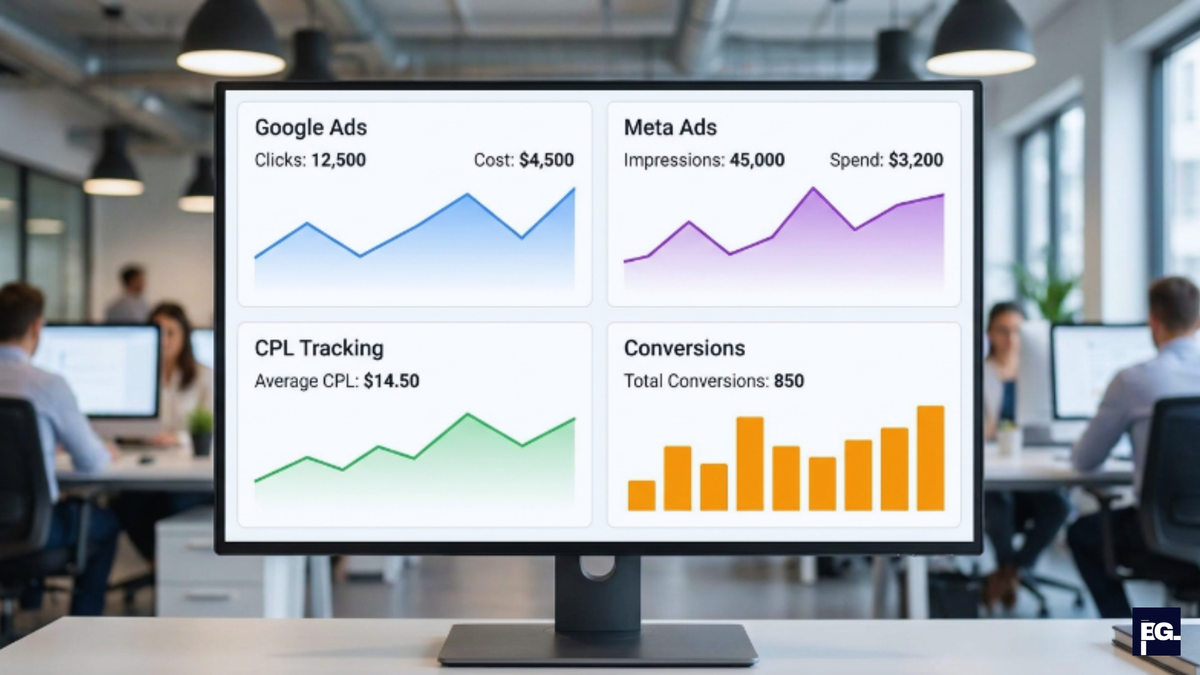
Paid channels like search, social, and display are powerful when they’re intentional. They’re also where lead generation budgets disappear fastest when there’s no clear targeting or landing strategy.
Studies on cost per lead show big variation: for example, PPC can average around $463 per lead, while SEO-driven leads can be closer to $206 on average, and webinars and email come in lower still for some B2B industries. (SoPro CPL benchmarks).
How to put this into practice
- Use search ads for high-intent queries (“marketing automation software demo”, “CRM for agencies”), and send them to strong landing pages.
- Use LinkedIn or Meta for colder audiences, but narrow targeting and use clear value-led offers instead of generic “learn more”.
- Always track conversions and CPL (Cost Per Lead) in your analytics and ad platforms; if you can’t measure leads, don’t scale the campaign.
Example: One B2B benchmark report notes that organic search and email often convert at higher rates (roughly 2.4-2.7%) than some paid channels, while social can sit closer to 1% or less in many industries. For a client overspending on social ads, we shifted budget towards high-intent search and email nurture; total lead volume went up while CPL went down.
Step 6: Nurture leads with email and simple automation
Leads rarely convert on the first touch, especially in B2B or higher-ticket services. You need a way to stay present with value over weeks or months.
Email is still one of the most cost-effective ways to do this. According to HubSpot and Litmus, email marketing delivers an average ROI ranging from 10:1 to 36:1 — meaning roughly $36 returned for every $1 spent — making it one of the highest-ROI channels available for lead nurture.
How to put this into practice
- Create a 4–6 email sequence for each key offer: welcome, quick win, case study, objection handling, CTA reminder.
- Segment leads by interest (e.g., SEO vs design vs CRM) so emails feel relevant, not generic blasts.
- Mix education and offers: share useful insights, then invite them to a call, demo, or audit when it makes sense.
Example: For a client offering marketing automation services, we added a simple nurture flow for leads who downloaded a “funnel audit checklist.” Over a few months, the email sequence consistently turned a portion of those leads into discovery calls without increasing ad spend, because it kept the brand top-of-mind and built trust.
Step 7: Use lead scoring and qualification
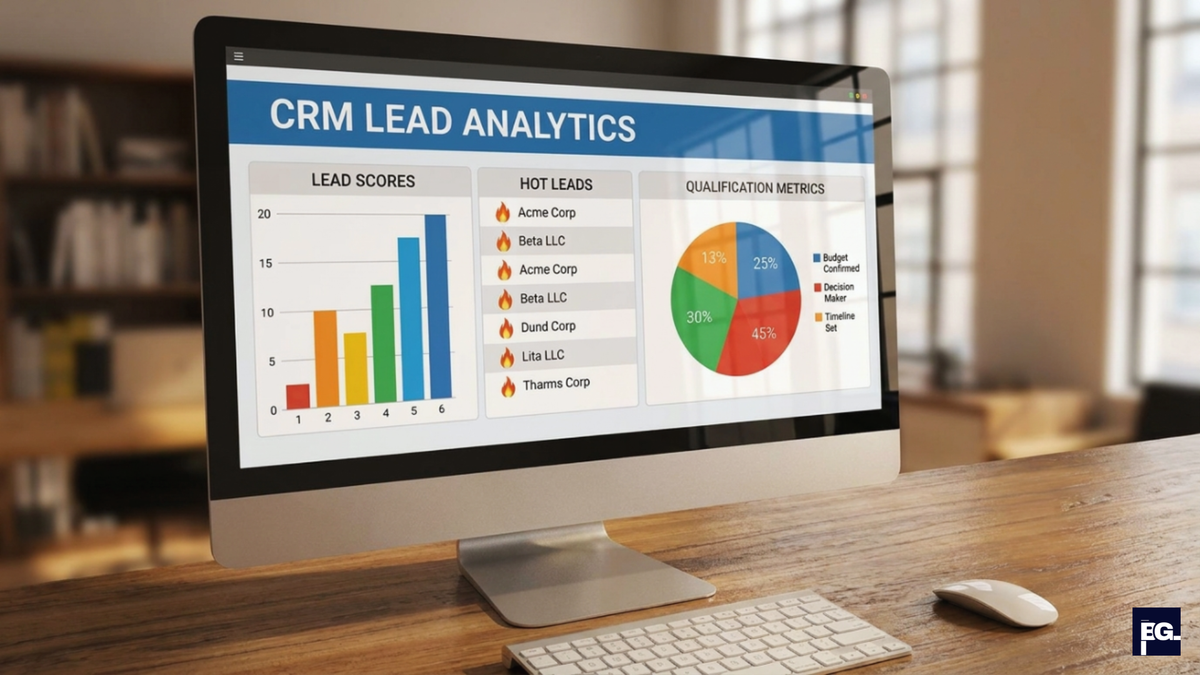
If every form fill is treated as an equally hot lead, sales gets overwhelmed and frustrated. They need a way to prioritize the people who are most likely to buy.
Lead scoring combines fit (do they match your ICP?) and behavior (what have they done on your site or in your emails?) to decide who should be fast-tracked to sales. Salespanel talks about using behavioral tracking and scoring to identify the 10–20% of visitors who are actually worth outreach.
How to put this into practice
- Assign points for actions: page visits, content downloads, webinar attendance, pricing page views, email clicks.
- Add negative scoring for bad-fit industries or students/job seekers if they’re not your target.
- Create rules: for example, when a lead hits a certain score and fits your ICP, send them to the sales team with context on what they did.
Example: For a B2B client, we found that leads who visited the pricing page at least twice and opened two nurture emails had much higher close rates. We used that behavior as part of our scoring system and flagged those leads as priority for the sales team.
Step 8: Track CPL and funnel conversion, not just clicks
It’s easy to get excited about high click-through rates or impressions, but none of that matters if leads are too expensive or don’t close. Good lead generation in digital marketing relies on basic math: cost per lead (CPL), conversion rates, and eventually, revenue.
B2B benchmark data shows that average B2B website conversion rates sit roughly between 2–5%, and that when you multiply the conversion rates at each stage (visitor → lead → opportunity → customer), you see why you need a steady flow of qualified leads to hit your targets. CPL also varies significantly by channel, with paid ads, events, and outbound often costing more per lead than SEO, email, or multi-channel inbound.
How to put this into practice
- Track CPL per channel: ad spend or marketing cost divided by number of leads.
- Track funnel conversion: visitor → lead, lead → MQL, MQL → SQL, SQL → customer.
- Compare your numbers to benchmarks, but focus more on improving your own baseline month over month.
Example: SoPro’s 2025 report shows SEO leads averaging around $206 CPL compared to over $460 CPL from PPC in some B2B contexts. For a client overspending on paid search, this comparison helped justify shifting some budget into content and SEO while still using paid for carefully targeted, high-intent campaigns.
Step 9: Align marketing and sales on what a “good lead” is
One of the biggest silent killers of lead generation digital marketing is misalignment. Marketing celebrates “100 new leads,” while sales complains that none of them are ready to buy.
First Page Sage’s B2B sales funnel benchmarks show that only a small percentage of leads become real sales opportunities with data citing around 13% of B2B leads becoming opportunities on average, with even fewer closing. That’s not a failure of lead generation digital marketing — it’s a reminder that sales and marketing teams need to agree upfront on what counts as a qualified lead.
How to put this into practice
- Sit with sales and define what MQL and SQL mean in your context: roles, company size, budget, timeline.
- Share regular reports on lead sources, CPL, and close rates so everyone sees the full picture.
- Use feedback from sales calls to refine your targeting, offers, and messaging.
Example: After reviewing calls, one client learned that a particular segment (very small businesses) never converted, even though they filled forms. We excluded that segment from targeting and adjusted our messaging. Lead volume dropped slightly, but opportunities and revenue went up.
Step 10: Test, improve, and recycle what works
Finally, lead generation in digital marketing is not a one-time project. The teams that win treat it as an ongoing experiment.
Landing page benchmark reports show that the difference between median performance (around 6.6% conversion) and top performers (10–15%+) usually comes from systematic testing like headlines, layouts, offers, and traffic sources, not a single magic trick.
How to put this into practice
- Run A/B tests on key touchpoints: landing page headlines, CTA copy, hero images, and offers.
- Check performance monthly and refresh creatives, audiences, or bids based on real data.
- Repurpose high-performing content into other formats: blog posts into lead magnets, webinars into video snippets, guides into email series.
Example: For one client, we discovered that a simple “audit” offer outperformed a generic “consultation” across multiple channels. We recycled that offer into different formats—landing pages, ads, emails, and webinars—and used it as the main hook in their lead generation digital marketing for the year.
Final thoughts: build a lead system, not random campaigns
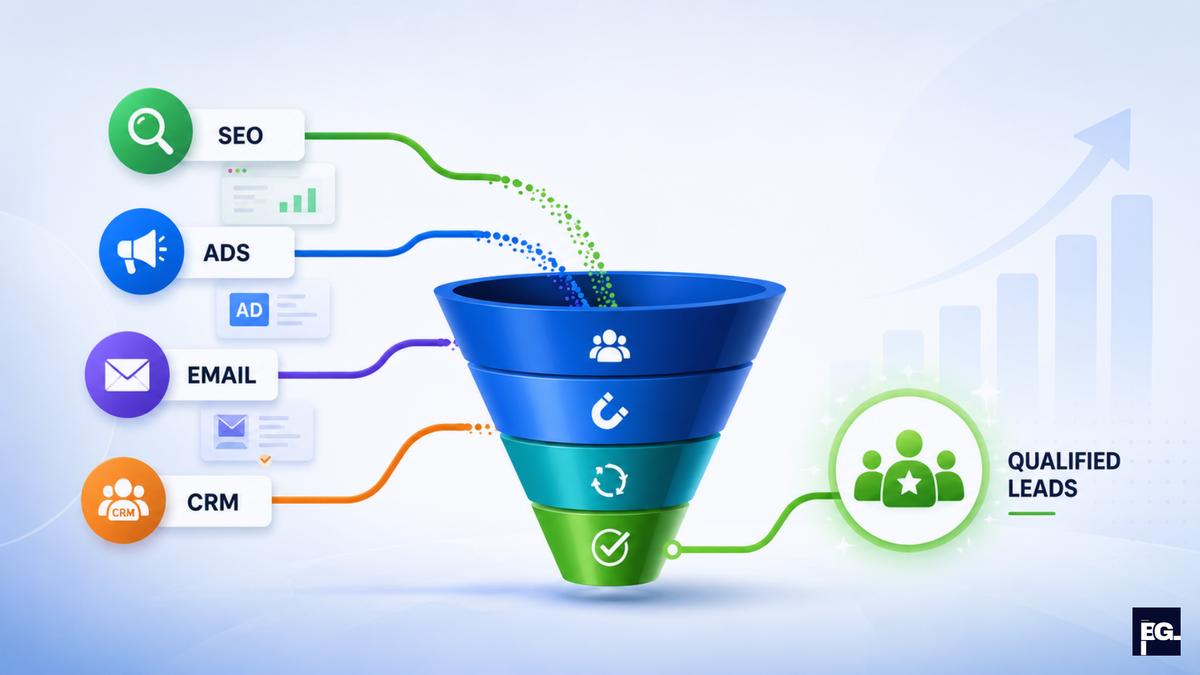
At the end of the day, generating more leads with digital marketing is not about copying the latest hack. It’s about building a simple, honest system: the right people, the right message, the right offer, and a clear path from first click to conversation.
In my experience, the biggest wins come when you stop chasing “vanity metrics” and start caring about clear offers, focused landing pages, consistent nurture, and real numbers like CPL and close rates. When your channels support each other, content, SEO, ads, email, and sales, you start seeing steady, predictable lead flow instead of random spikes.
If you want support for building or improving your lead generation system, contact BrainGig. Our team can help you with strategy, content, landing pages, tracking, and campaigns so your digital marketing actually turns attention into qualified leads.
Summary: Topics Learned
Q: What is the first step to generate more leads with digital marketing?
A: Start by defining your ideal customer and a clear offer. Without this, your campaigns attract random traffic instead of qualified leads, and your messaging stays vague.
Q: Why does content matter so much for lead generation?
A: Helpful content and SEO attract people who are already searching for answers, and studies show content marketing can generate about 3× more leads at around 62% lower cost than traditional outbound approaches.
Q: How do landing pages affect lead generation performance?
A: Focused landing pages with one clear offer and CTA usually convert better than generic pages. Benchmarks put median landing page conversion around 6.6%, with top performers reaching 10–15%+.
Q: How should I measure if my lead generation is working?
A:Track cost per lead, conversion rates through each funnel stage, and revenue by channel. Compare your numbers with B2B benchmarks (2–5% conversion in many cases), but most importantly, improve your baseline over time.
Q: What makes lead generation in digital marketing sustainable instead of random?
A: A sustainable system combines clear positioning, useful content, targeted campaigns, strong landing pages, email nurture, lead scoring, and regular testing so you’re always learning and improving rather than guessing.