


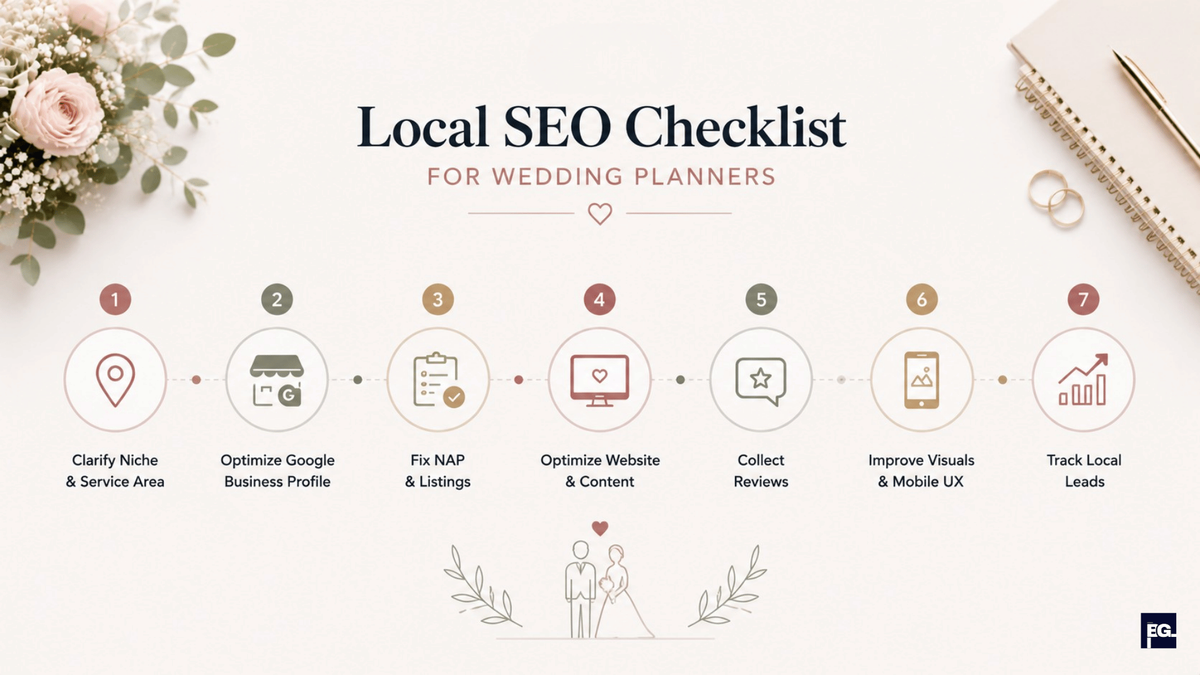
Quick snapshot: local SEO checklist for wedding planners
| Step | What it means | Simple action to take |
|---|---|---|
| 1. Clarify niche & area | Make it clear where you work and what weddings you specialize in so the right couples can find you. | Add “wedding planner in [city]” + your style (e.g., luxury, intimate) to your homepage, About, and Services pages. |
| 2. Optimize Google Business Profile | A complete, photo-rich GBP gets more views, clicks, and calls from local search and Maps. | Fill in every field, pick the right categories, add many real wedding photos, and post occasional updates. |
| 3. Fix NAP & listings | Consistent Name, Address, Phone across the web helps Google trust your business and show it locally. | Standardize your NAP on your website, GBP, social profiles, and key wedding directories. |
| 4. Optimize website & content | Local keywords and helpful blogs attract couples searching for planners, venues, and ideas in your area. | Use “wedding planner in [city]” in titles and headings, and publish simple local guides and venue posts. |
| 5. Collect reviews | Reviews are a major trust and ranking factor for local services, especially for weddings. | Ask every happy couple for a Google review and at least one review on a major wedding platform. |
| 6. Improve visuals & mobile UX | Strong photos and a mobile-friendly site help couples choose you and support better local SEO. | Upload high-quality images to GBP and your site, compress them, and test your site on a phone. |
| 7. Track local leads | Measuring calls, forms, and bookings shows which local SEO efforts really bring clients. | Ask “How did you find me?”, track calls and forms, and invest more in what drives real inquiries. |
1. Clarify your local niche and service area
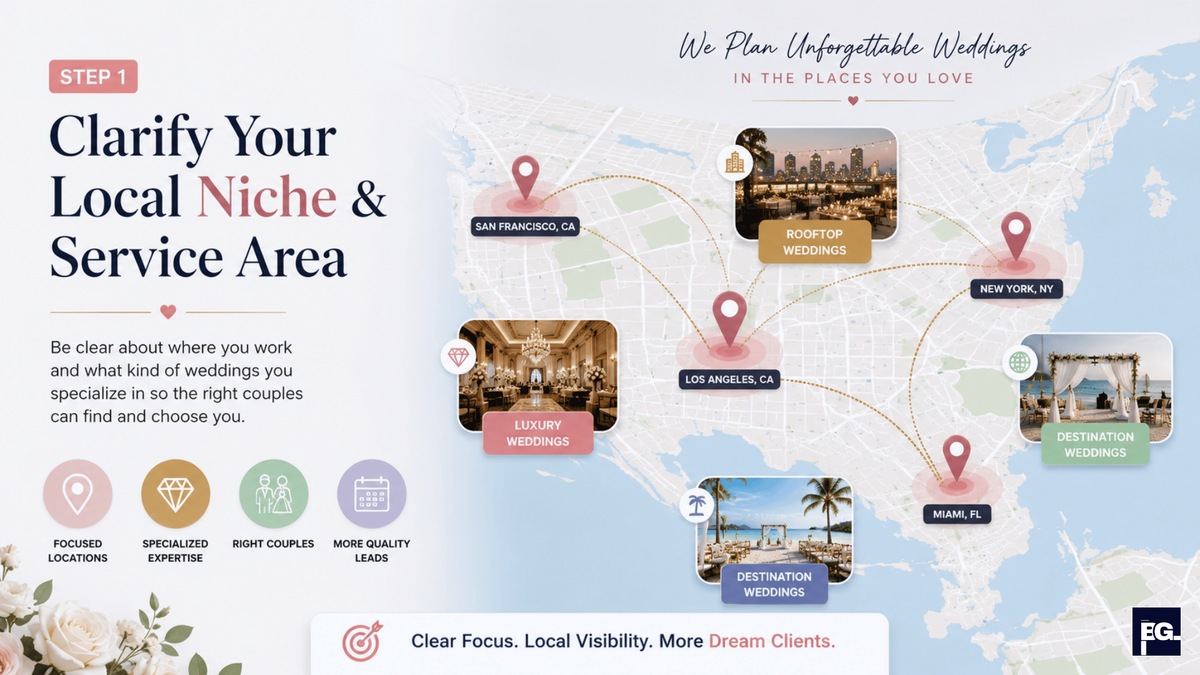
When I audit wedding planner websites, one of the most common issues is vague positioning. The site looks pretty, but it doesn’t clearly say where you work or what kind of weddings you focus on.
According to BrightLocal, 46% of all Google searches have local intent, and studies show that 80% of consumers research local businesses online before visiting or contacting them. If your city and niche are not obvious, you’ll miss a lot of couples who are actively searching.
How to apply this
- Decide on 1–3 main locations (cities/regions) you want to be known for.
- Decide on your core styles e.g., intimate weddings, luxury hotel weddings, destination events, or budget-friendly planning.
- Make sure your homepage headline and first paragraph say something like: “Wedding planner in [city] specializing in [style].”
Simple example: Instead of “I help couples plan beautiful weddings,” use:“I'm a wedding planner in New York specializing in intimate hotel and rooftop weddings.”
That small change helps both Google and couples understand your focus, which is key for wedding planner marketing and local SEO.
2. Fully optimize your Google Business Profile
Your Google Business Profile is the heart of local visibility. It’s what shows up when someone types “wedding planner near me” or looks at the map.
According to Google, complete and active GBPs get significantly more engagement. A study by BrightLocal found that complete profiles generate up to 7x more clicks than incomplete ones , and listings with photos receive 42% more direction requests and 35% more website clicks than those without.
How to apply this
- Claim and verify your GBP, if you haven’t already.
- Set “Wedding Planner” as your main category and add a relevant secondary category if needed (e.g., “Event Planner”).
- Add your NAP, website, hours, service area, and a clear description mentioning “wedding planner in [city].”
- Upload plenty of real photos, ceremonies, receptions, detail shots, and behind-the-scenes. Google and independent analyses report that according to Google, businesses with photos receive 42% more direction requests and 35% more website clicks.
- Post occasional updates with tips, recent weddings, or special offers.
Simple example: A planner with a verified GBP, clear description, 80+ high-quality photos, and consistent posts will usually be more visible and more trusted than a planner with a half-completed profile and a handful of images.
3. Fix NAP consistency and core listings
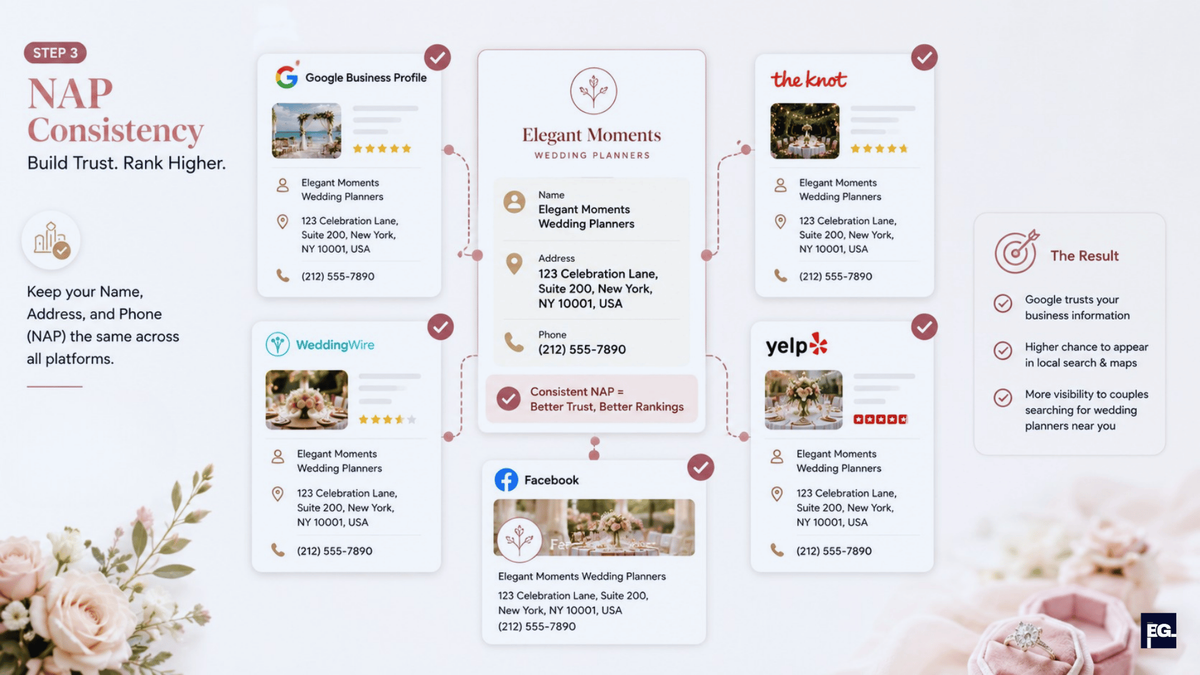
Google cross-checks your business information across the web. If your Name, Address, or Phone number are inconsistent, it can weaken your local SEO signals and confuse both Google and couples.
How to apply this
- Decide on a single, exact version of your business name, address, and phone number.
- Update your NAP on:
- Your website (especially in the footer and contact page)
- Google Business Profile
- Social profiles (Facebook, Instagram, etc.)
- Key wedding and local directories (WeddingWire, The Knot, Zola, local business listings).
Simple example: If you’re listed as “Dream Day Weddings,” “Dream Day Wedding Planning,” and “Dreamday Weddings” in different places, standardize them all to one format everywhere. This is a quick but important item in your local SEO checklist.
4. Optimize your website for local keywords and helpful content
Your website still plays a big role in SEO for wedding planners. In fact, 76% of people who conduct a local search visit a business within 24 hours (Think with Google) , and for wedding planners, that visit often starts with your website, where couples check your portfolio, pricing, and services before reaching out.
How to apply this
- Use local phrases in key spots:
- Page titles and meta descriptions (e.g., “Wedding Planner in [City] | [Brand Name]”)
- Main H1 and H2 headings
- First paragraphs on your homepage and services pages
- Write a few simple, localized blog posts such as:
- “Best Wedding Venues in [City] for Intimate Ceremonies”
- “How to Plan a Monsoon-Season Wedding in [Region]”
- “Wedding Day Timeline for [City] Couples”
- Connect your posts to your services and contact pages so couples can move from learning to contacting you easily.
Simple example: A blog called “Top 7 Rooftop Wedding Venues in Houston” that includes your honest insights and photos is great wedding planner marketing and local SEO. Couples searching venues may find your article first, then discover you as a planner.
5. Collect reviews and showcase them
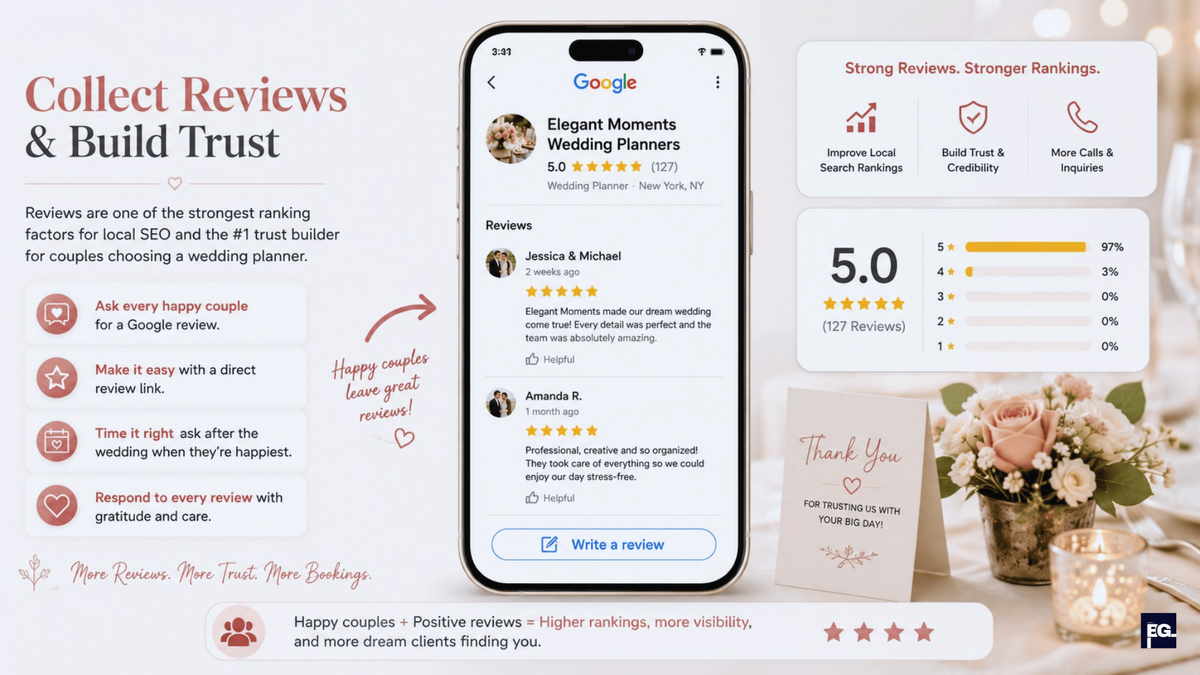
Weddings are high-trust decisions. Reviews are one of the main ways couples decide who to contact.
According to ReviewTrackers, the top three factors that influence consumers' decisions in local search are photos, Google reviews, and position in results. For wedding planners, this matters even more , hiring a planner is a high-trust, high-investment decision, and most couples will read your reviews carefully before ever sending an inquiry.
How to apply this
- After each wedding, send a friendly message with direct links asking the couple to review you on Google and at least one major wedding platform.
- Gently prompt for specific details in the review (location, style, what you helped with).
- Feature your best reviews on your homepage, services pages, and GBP description.
Simple example: A planner with 30–50 recent, detailed reviews across Google and wedding sites will usually attract more local leads than a planner with only a few vague reviews, even if both have similar websites.
6. Use strong visuals and a mobile‑friendly experience
Weddings are visual by nature. Couples often scan photos first, then read text. At the same time, Semrush shows that 57% of local searches now happen on mobile devices, so your site and listings must work beautifully on phones.
In fact, according to Google, businesses with photos on their profile receive 42% more direction requests and 35% more website clicks than those without.
How to apply this
- Upload real, high-quality photos of your weddings to your GBP and website like ceremony setups, reception decor, happy couples, and behind-the-scenes moments.
- Give images descriptive file names and alt text (e.g., “outdoor-wedding-planner-houston.jpg”).
- On mobile, check that your site loads quickly, buttons are easy to tap, and key info (who you are, where you work, how to contact you) is visible without a lot of scrolling.
Simple example: If your GBP and site only have a handful of low-quality images and your homepage is slow on 4G, couples are likely to tap back and choose another planner with clearer visuals and a smoother mobile experience.
7. Track local leads and keep improving
Finally, a local SEO checklist only works if you know what's actually generating inquiries and bookings. Google reports that 28% of local searches result in a purchase , but only planners who are actively tracking can tell which part of their strategy is driving that.
Semrush reports that local map pack businesses get 93% more calls, clicks, and direction requests. Semrush also mentions that a large percentage of local mobile searches convert, which underlines how important it is to measure outcomes, not just clicks.
How to apply this
- Ask every new inquiry “How did you find me?” and record the answer.
- Track form submissions and calls in your analytics setup and customer relationship management (CRM).
- Review which pages, search terms, and listings bring the best leads, then double down on those.
Simple example: If you see that most qualified inquiries mention “Google” and often land on your “Wedding Planner in [City]” page or a specific blog about local venues, you know those are assets you should keep updating and promoting.
Final thoughts: local SEO that actually books weddings
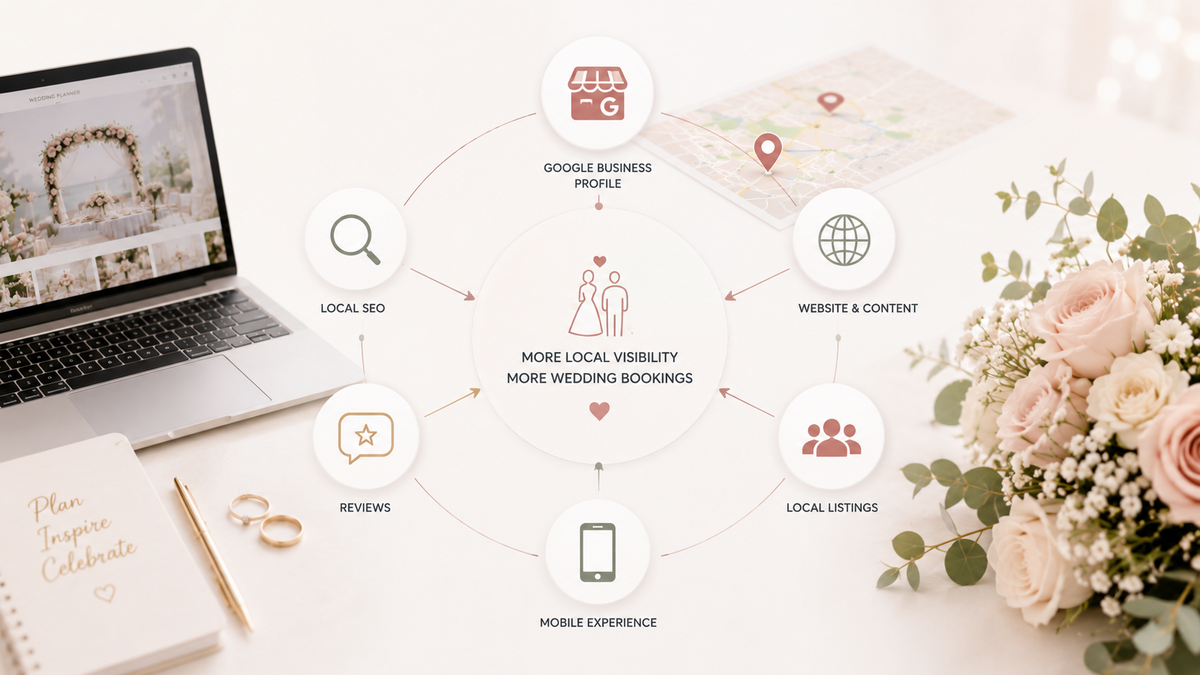
From what I’ve seen, local SEO for wedding planners works best when you treat it as a simple, ongoing habit instead of a one-time project.
When your niche and service area are clear, your Google Business Profile is complete, your website speaks your city’s language, your reviews tell real stories, and your photos and mobile experience feel inviting, you make it easy for couples to find you and trust you before you ever speak.
If you’d like help building or improving this system, from auditing your current presence to implementing this local SEO checklist and shaping your wedding planner marketing strategy, contact BrainGig. Our team can support you with local SEO, content, and website improvements so you can focus on planning unforgettable weddings while your visibility grows.
Summary: Topics Learned
Q: What is the first step in this local SEO checklist for wedding planners?
A: Start by defining your local niche and service area clearly so Google and couples know exactly where you work and what types of weddings you specialize in.
Q: Which platforms matter most for local visibility?
A: Your Google Business Profile, your own website, and key wedding platforms like WeddingWire, The Knot, and Zola, because couples and search engines use them heavily to evaluate local wedding businesses.
Q: How does content support local SEO for wedding planners?
A: Localized blog posts and guides about venues, seasons, and planning tips attract couples early in their journey, build authority, and create natural ways to target “wedding planner [city]” and related queries.
Q: What role do reviews and photos play in local SEO?
A: Reviews and visuals are core trust signals; they can significantly influence both rankings and conversion rates, especially for emotional decisions like weddings where couples compare multiple planners online.
Q: How do you know if your local SEO checklist is working?
A: Track Google Business Profile views and actions, website traffic from local queries, calls, form submissions, and actual bookings. Over time you should see more local discovery, more qualified inquiries, and a higher share of bookings coming from search.